Gold-bearing arsenopyrite from the mineralization of Rózsabánya, Börzsöny Mts, N Hungary
DOI:
https://doi.org/10.23928/foldt.kozl.2026.156.3.287Keywords:
arsenopyrite, trace elements, ICP-MS, ICP-OES, EPMAAbstract
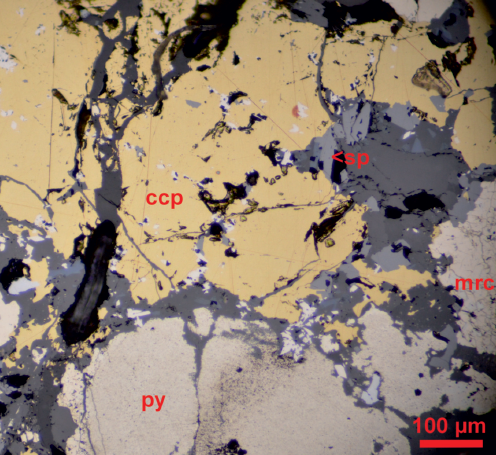
The Au(-Pb-Zn-Ag-Cu) mineralization of Rózsabánya in the Börzsöny Mts contains critical elements, such as As, Bi, Co and Sb. The main As-bearing mineral of the deposit is arsenopyrite, that appears in two different forms. The earlier crystallized arsenopyrite (arsenopyrite-I) is characterized by large (from ~100 µm–2 mm) euhedral-subhedral crystals, porous texture and native gold in its pores, while arsenopyrite-II forms smaller (10–50 µm) euhedral crystals, without observable native gold inclusions. Bismuth occurs as native bismuth, bismuthinite, and bismuth-sulfosalts, and Co mostly appears as trace elements in other sulfides (e.g., arsenopyrite, pyrrhotite, pyrite). In this study we investigated the trace element content of 53 ore-concentrates using inductively coupled plasma optical emission spectroscopy (ICP-OES) and inductively coupled plasma mass spectroscopy (ICP-MS) to obtain quantitative information about the trace element content of the mineralization, as well as the composition of arsenopyrite using electron probe micro-analysis (EPMA), to get a more accurate understanding of the element migration during the ore-forming processes.
Based on the positive correlation of Au, Bi, and Co with As in the ore-concentrates, a strong genetic relationship can be suggested between these elements and the arsenopyrite. According to our results, both arsenopyrite generations contain trace elements, such as Co, Ni, Sb and Au, but the later crystallized arsenopyrite-II is more enriched in these elements. This observation supports the partial remobilization of previously precipitated minerals (e.g., arsenopyrite-I, pyrrhotite). Based on the correlations of the major and trace elements in arsenopyrite, Co and Ni can substitute Fe in the structure of arsenopyrite, while Au might occur mainly as nanoinclusions, although its chemically-bound presence cannot be completely excluded.
Downloads
Published
How to Cite
Issue
Section