From invisible gold in arsenian pyrite to gold-rich brown “muds” in karst cavities: supergene Au–Ag remobilisation in the Bigar area, Western Timok, Serbia
DOI:
https://doi.org/10.23928/foldt.kozl.2026.156.3.303Keywords:
karstic redeposition, goethite–hematite pseudomorphs, sulphide oxidation, redox fluctuations, secondary mineral formation, petrovskaiteAbstract
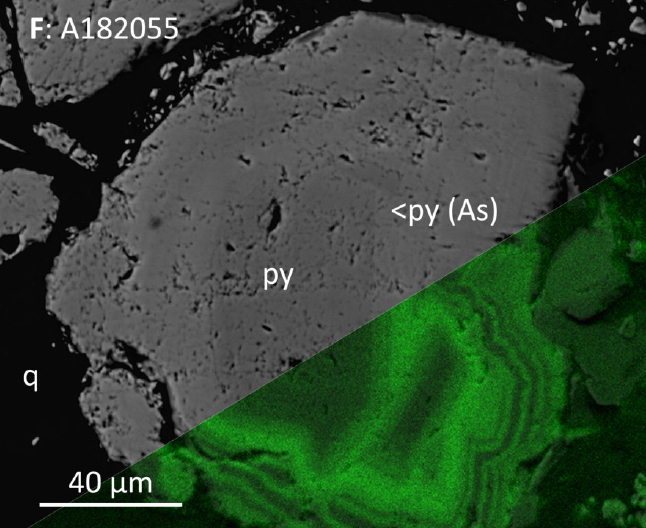
In the northwestern part of the Timok Magmatic Complex, Serbia, brown, earthy–clayey karst-infill materials occur within the carbonate rocks of the Bigar–Korkan area, with gold contents locally exceeding 10 ppm. Field observations, mineralogy, grain-size distribution, electron microscopy, and electron microprobe data from samples collected mainly in the Bigar area were evaluated together to reconstruct their paragenetic evolution. The studied brown “mud” is a clay-rich assemblage consisting of a heterogeneous mixture of detrital silicates, secondary Pb–Mn phases, and angular to rounded Fe oxide/oxyhydroxide pseudomorphs after pyrite. Angular and rounded grains, concentric goethite–clay coatings and layer-parallel Fe-rich precipitates suggest the coexistence of reworked grains and later mineral precipitates. Native gold, electrum, and Au–Ag sulphide occur mainly in the inner parts of these pseudomorphs, whereas their porous outer parts are commonly depleted in precious metals. The analysed Au-rich Au–Ag sulphide has a petrovskaite-like composition, but its mineral species cannot be identified with certainty. According to the proposed model, the inferred invisible gold in the initial, fresh As-bearing pyrite was followed by sulphide oxidation and then by short-range, thiosulphate-assisted Au–Ag remobilisation in a carbonate-buffered environment. Carbonate dissolution liberated the resistant, gold-bearing pseudomorphs, which were transported into karst cavities and concentrated there. Fluctuations in the karst water table may have changed oxygen availability: falling water levels likely promoted oxidation, whereas oxygen depletion in water-filled cavities with restricted water exchange likely led to the development of locally reducing conditions. In the presence of dissolved sulphide, these conditions may have favoured late precipitation of Au–Ag, Ag, and Ag–Hg sulphides. Renewed oxidation likely caused the breakdown of sulphide minerals in the outer grain zones. The exceptionally high gold contents are therefore the combined result of chemical remobilisation, removal of barren carbonate, and physical concentration of gold-bearing grains in karst traps. These findings suggest that karst infills containing Fe oxide/oxyhydroxide grains should be considered potential gold exploration targets where karstification affects sulphide-bearing carbonate rocks. Exploration for such accumulations may be supported by geochemical, geophysical and remote-sensing methods.
Downloads
Published
How to Cite
Issue
Section