Zirconolite-bearing symplectites in micro-ijolites: implications for subsolidus processes during ongoing magmatism at Oldoinyo Lengai, Tanzania
Abstract
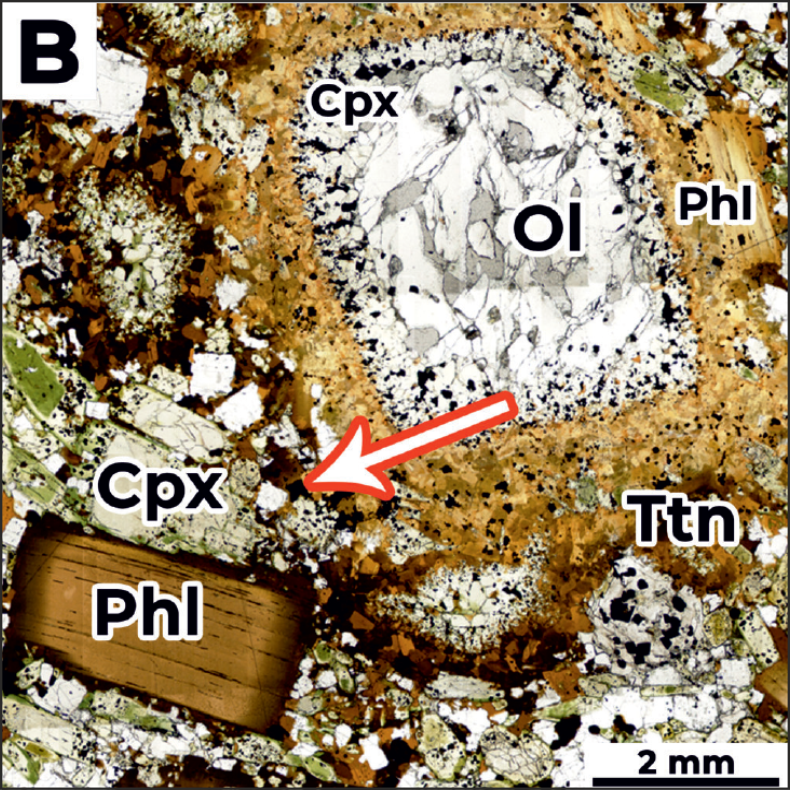
Olivine-phlogopite micro-ijolite enclaves from Oldoinyo Lengai record complex, multistage magmatic processes. These rocks preserve evidence of subsolidus reactions demonstrated by the development of symplectites. The symplectites studied here are present in lamellae and display bimodal grainsize distributions of their constituent phases: diopside and ilmenite occur as both coarse- (2–3 µm) and fine-grained (<2 µm) lamellae, whereas zirconolite forms only in coarse- (~5 µm) and REE-perovskite medium-sized lamellae. The bimodality reflects crystallization at different temperatures. For the thermal evolution of the micro-ijolite, two parageneses have been discovered: at high-temperature the “diopside-paragenesis” (970–1070 °C), whereas and at lower-temperature “aegirine-augite-paragenesis” (700–850 °C) was formed. Coarse-grained lamellae’s formation corresponds to the high-T formation, and the fine-grained ones formed during the low-T evolution steps. The symplectites likely formed through a subsolidus reaction between olivine and titanite, forming diopside, ilmenite and zirconolite as reaction products. Titanite’s breakdown in this reaction and thus the deliberation of its ZrO2 (0.4–0.8 wt%) were the major factors controlling zirconolite formation. Transmission electron microscopy analyses revealed that zirconolite crystals are near-ideal in composition, belong to the zirconolite-2M polytype and composed of two twin domains. The twin axis is parallel to [110], resulting in 180° rotation around the [110], with the contact plane parallel to (001). Our findings demonstrate that subsolidus processes may operate simultaneously with magmatic crystallization, as recorded by the textures and mineral assemblages within these rocks from Oldoinyo Lengai.