Intracellular bodies in magnetotactic bacteria and their possible geochemical significance
DOI:
https://doi.org/10.23928/foldt.kozl.2026.156.3.257Keywords:
magnetotactic bacteria, magnetite, polyphosphate, elemental sulfur, amorphous calcium , carbonate, transmission electron microscopy (TEM)Abstract
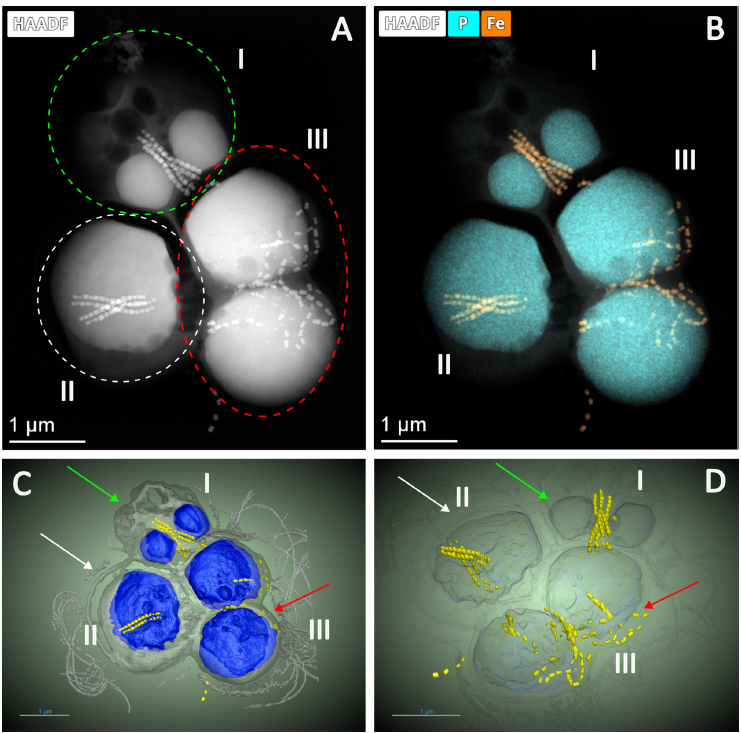
Magnetotactic bacteria (MTB) are able to sense the Earth’s magnetic field direction through chains of membrane-bound iron oxide or iron sulfide minerals, known as magnetosomes. By aligning and migrating along these magnetic field lines, the cells are able to locate their position within optimal oxygen gradients in aquatic environments. Although the presence of magnetic nanocrystals is their most distinctive characteristic, MTB may also contain intracellular granules of polyphosphate (polyP), elemental sulfur (S), and amorphous calcium carbonate (ACC). MTB-containing samples collected from Kinizsi-spring, near Nagyvázsony in autumn, winter and spring were studied using transmission electron microscopy. We investigated both the freshly collected samples and the changes that occurred over time during laboratory storage. Regarding the fresh samples, our primary aim was to obtain a preliminary overview of the cell types and their intracellular inclusions. It was observed that the type of inclusion – present within a given cell type – was associated with other cellular characteristics, whereas the occurrence of inclusions varied with season. These findings suggest that inclusion type is under genetic control but is simultaneously influenced by environmental conditions. As magnetotactic bacteria (MTB) continuously migrate between microoxic and anoxic zones, their polyphosphate (polyP) and elemental sulfur (S) inclusions may play an important role in the biogeochemical cycling of phosphorus and sulfur, and in shaping their distribution within aquatic environments. In the laboratory-stored samples, shifts in the dominance of different MTB cell types were observed after several months. To analyze temporal patterns in greater detail, the winter sample was divided into four equal subsamples and examined monthly over a three-month period. Over time, the dominant cell type changed within each microcosm and polyphosphate (polyP)-containing cell types generally became predominant. Electron tomography was performed on three coccoid cells, enabling the three-dimensional assessment of the spatial arrangement of intracellular inclusions. The distribution of inclusions was consistent with a balanced mass distribution within the cell and may facilitate swimming along magnetically guided trajectories. Some coccoid cell types contained extremely large polyP inclusions relative to their cell size. These observations highlight the potential of MTB for technological applications, particularly in the removal of phosphorus from aqueous solutions.
Downloads
Published
How to Cite
Issue
Section