Simulation of space weathering by the analysis of irradiated meteorites
Abstract
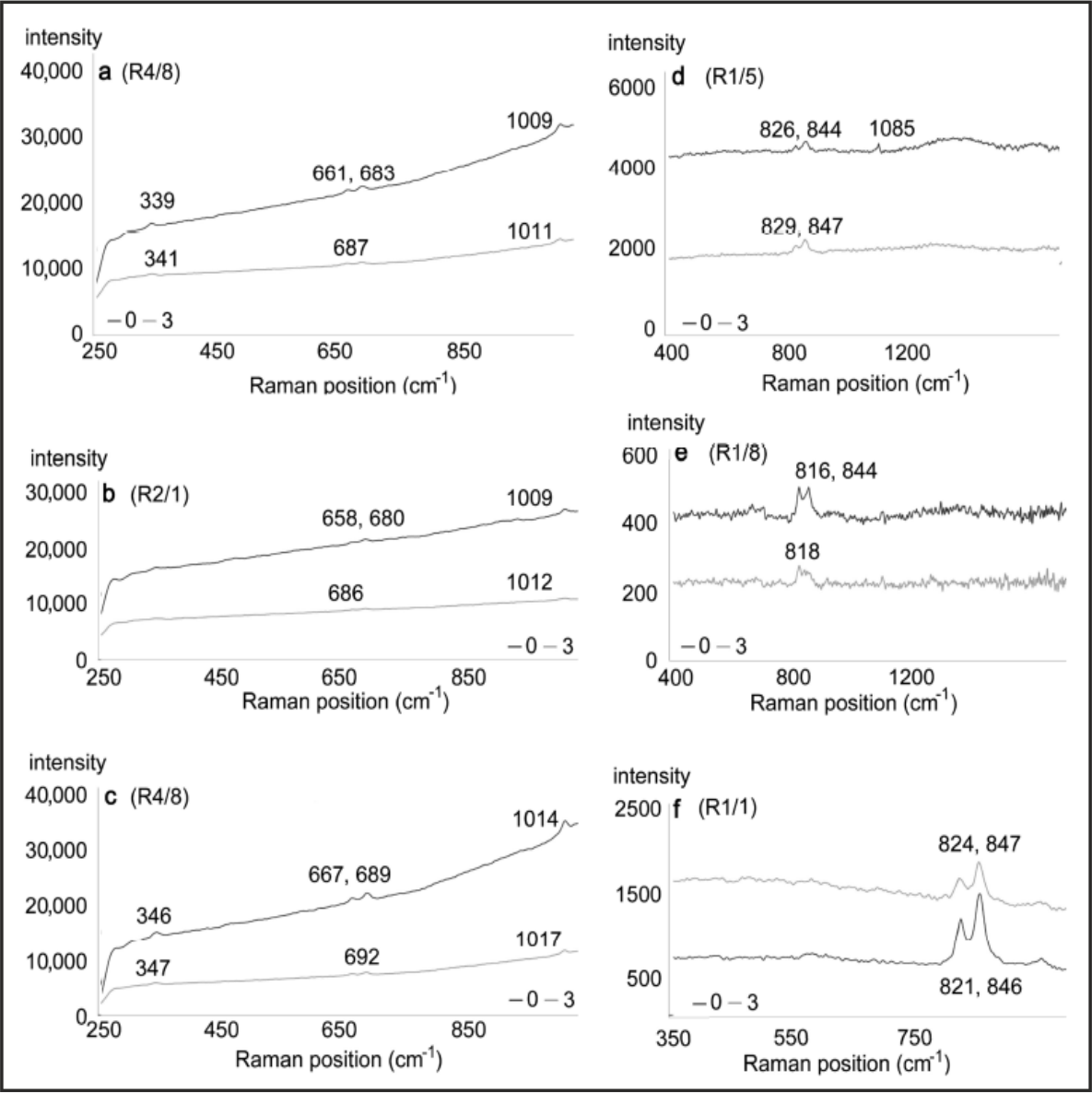
Raman and infrared spectroscopic measurements were performed on a CO3-type carbonaceous chondrite sample designated NWA 10580, at identical measurement points before and after three successive proton irradiation cycles. To simulate cosmic weathering under laboratory conditions, the sample was irradiated with 1 keV protons at flux values of 1011, 1014, and 1017 ions/cm² for each experimental cycle. Following irradiation, the Raman spectroscopic measurements revealed changes in the full width at half maximum (FWHM) and peak positions of the main spectral bands. In both the Raman and FTIR spectra, several low-intensity bands (663, 697, 913 cm–1) of piroxen (FTIR), and 658 cm–1 piroxen (Raman), while for olivine 978 cm–1 (FTIR) disappeared after irradiation. In the infrared region the pyroxene bands exhibited both positive [at smaller peaks (664 cm–1: +3 cm–1, 913 cm–1: +1 cm–1)] and negative peak shifts, whereas olivine primarily showed negative peak shifts (894 cm–1: –7 cm–1, 978 cm–1: –8 cm–1) and, in several cases, the disappearance of minor peaks. The loss of these low-intensity peaks in both the infrared and Raman spectra indicates amorphization of the respective mineral phases. The most stable spectral bands identified in this way may contribute to the future optimization of detector systems on space probes, as well as to the correlation of meteorite samples with their parent asteroids.