The relationship between gentrification and public transport investments: a study on French cities
Abstract
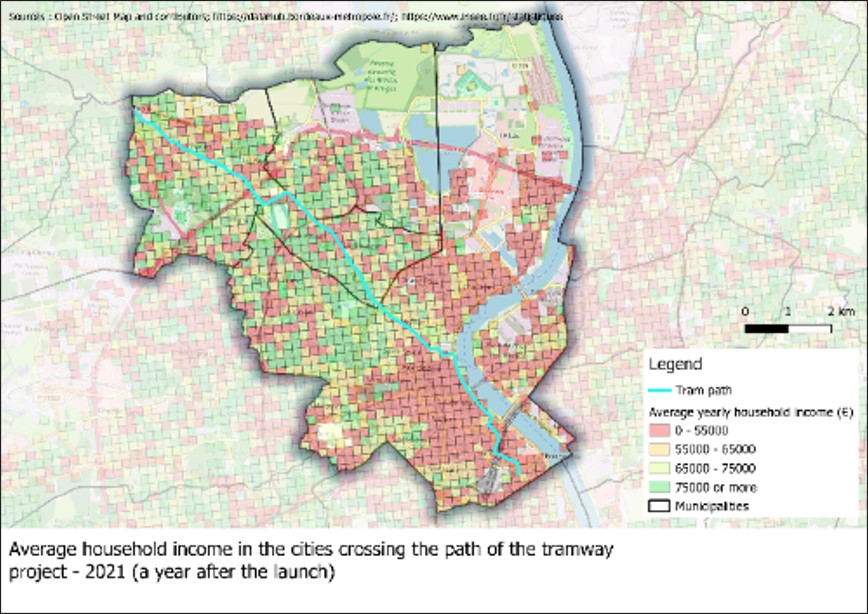
Socio-spatial dynamics, such as gentrification, often result from urban planning and development processes that include public transport investments. The construction of a new tramline (or light-rail transit, LRT) is one of the most impactful transport infrastructure projects that can be implemented within a territory. This work focuses on the fourth tramline in Bordeaux (France), which crosses 3 suburban municipalities with different accessibility and socio-economic profiles. It aims to evaluate the impact of this project on multiple indicators: population density, the socio-professional composition of the population, average household income, and the number of poor households, to detect a possible gentrification process. Municipal data, as well as grid-based data from the French national statistics institute, were used to obtain a global view of cities’ dynamics, and a more precise view at a 200 × 200 m cell scale. Using a GIS tool and R for visualisation, the evolution of those indicators over the course of the implementation was studied. The results show an acceleration in density growth, most evident in the peripheral cities farthest from the city centre, as well as a subtle, nuanced increase in the proportions of higher-income socio-professional groups. Gridded data on the population’s income along the tram’s route yield mixed conclusions: the study does not allow for the identification of a clear ongoing gentrification process. The research could be completed by evaluating other urban development indicators, such as housing market trends, and by collecting more data on the years following the launch to establish the project’s long-term impact.
References
Adetec (n. d.). Etudes et documents à télécharger. ADETEC. URL: http://www.adetec-deplacements.com/etudes.htm (Downloaded: 25 June 2026)
Bardaka, E., Delgado, M. S., Florax, R. J. G. M. (2018). Causal identification of transit-induced gentrification and spatial spillover effects : The case of the Denver light rail. Journal of Transport Geography. 71, 15–31. DOI: https://doi.org/10.1016/j.jtrangeo.2018.06.025
Crescenzi, R., Rodríguez‐Pose, A. (2012). Infrastructure and regional growth in the European Union. Papers in Regional Science, 91(3), 487–513. DOI: https://doi.org10.1111/j.1435-5957.2012.00439.x
Data.gouv.fr. (n. d.). Data.Gouv.Fr. URL: https://www.data.gouv.fr/datasets/decoupage-administratif-communal-francais-issu-d-openstreetmap (Downloaded: 25 June 2026)
Delmelle, E. C. (2021). Transit-Induced Gentrification and Displacement : The State of the Debate. Preprint. OSF. DOI: https://doi.org/10.31235/osf.io/5ka2g
Dong, H. (2017). Rail-transit-induced gentrification and the affordability paradox of TOD. Journal of Transport Geography. 63, 1–10. DOI: https://doi.org/10.1016/j.jtrangeo.2017.07.001
Dubé, J., Legros, D., Devaux, N. (2018). From bus to tramway : Is there an economic impact of substituting a rapid mass transit system? An empirical investigation accounting for anticipation effect. Transportation Research Part A: Policy and Practice. 110, 73–87. DOI: https://doi.org/10.1016/j.tra.2018.02.007
Dupas, R., Deschamps, J. C., Taniguchi, E., Qureshi, A. G., & Hsu, T. (2023). Optimizing the location selection of urban consolidation centers with sustainability considerations in the city of Bordeaux. Research in Transportation Business & Management, 47, 100943. DOI: https://doi.org/10.1016/j.rtbm.2022.100943
Eaton, J., Eckstein, Z. (1997). Cities and growth : Theory and evidence from France and Japan. Regional Science and Urban Economics. 27(4–5), 443–474. DOI: https://doi.org/10.1016/S0166-0462(97)80005-1
Géoportail (n. d.). Géoportail. République Française. URL: https://www.geoportail.gouv.fr/ (Downloaded: 25 June 2026)
He, S. Y., Tao, S., Cheung, Y. H. Y., Puczkowskyj, N., Lin, Z. (2021). Transit-oriented development, perceived neighbourhood gentrification and sense of community : A case study of Hong Kong. Case Studies on Transport Policy. 9(2), 555–566. DOI: https://doi.org/10.1016/j.cstp.2021.02.010
Higgins, C. D., Ferguson, M. R., Kanaroglou, P. S. (2014). Light Rail and Land Use Change: Rail Transit’s Role in Reshaping and Revitalizing Cities. Journal of Public Transportation. 17(2), 93–112. DOI: https://doi.org/10.5038/2375-0901.17.2.5
Hillnhütter, H., Sick Nielsen, T. A. (2026). The importance of walking for public transport – just the first and last mile? Transport Policy. 181, 104091. URL: https://doi.org/10.1016/j.tranpol.2026.104091
Ingvardson, J. B., Nielsen, O. A. (2018). Effects of new bus and rail rapid transit systems – an international review. Transport Reviews. 38(1), 96–116. URL: https://doi.org/10.1080/01441647.2017.1301594
Kapatsila, B., Palacios, M. S., Grisé, E., El-Geneidy, A. (2023). Resolving the accessibility dilemma : Comparing cumulative and gravity-based measures of accessibility in eight Canadian cities. Journal of Transport Geography. 107, 103530. URL: https://doi.org/10.1016/j.jtrangeo.2023.103530
Kasraian, D., Maat, K., van Wee, B. (2019). The impact of urban proximity, transport accessibility and policy on urban growth : A longitudinal analysis over five decades. Environment and Planning B: Urban Analytics and City Science. 46(6), 1000–1017. URL: https://doi.org/10.1177/2399808317740355
Ligne C du tramway de Bordeaux (2026). In Wikipédia. URL: https://fr.wikipedia.org/w/index.php?title=Ligne_C_du_tramway_de_Bordeaux&oldid=235340658
Ligne D du tramway de Bordeaux (2026). In Wikipédia. URL: https://fr.wikipedia.org/w/index.php?title=Ligne_D_du_tramway_de_Bordeaux&oldid=236795859
Marin, C., Werno, J., Le Campion, G., & Couderchet, L. (2024). Navigating discreetly: Spatial ecology of urban wild boar in Bordeaux City's landscape of fear, France. Science of the Total Environment, 954, 176436. DOI: https://doi.org/10.1016/j.scitotenv.2024.176436
Mohammad, S. I., Graham, D. J., Melo, P. C., Anderson, R. J. (2013). A meta-analysis of the impact of rail projects on land and property values. Transportation Research Part A: Policy and Practice. 50, 158–170. DOI: https://doi.org/10.1016/j.tra.2013.01.013
Nilsson, I., Delmelle, E. (2018). Transit investments and neighborhood change : On the likelihood of change. Journal of Transport Geography. 66, 167–179. DOI: https://doi.org/10.1016/j.jtrangeo.2017.12.001
Padeiro, M., Louro, A., da Costa, N. M. (2019). Transit-oriented development and gentrification : A systematic review. Transport Reviews. 39(6), 733–754. DOI: https://doi.org/10.1080/01441647.2019.1649316
Rietveld, P., Debrezion, G., Pels, E. (2007). the impact of railway stations on residential and commercial property value: A meta-analysis. The Journal of Real Estate Finance and Economics. 35, 161–180. DOI: https://doi.org/10.1007/s11146-007-9032-z
TBM. (n. d.). Toutes les infos sur la ligne D. TBM. URL: https://www.infotbm.com/fr/lignes/line:BMA:62 (Downloaded: 25 June 2026)
Veneri, P. (2018). Urban spatial structure in OECD cities: Is urban population decentralising or clustering? Papers in Regional Science. 97(4), 1355–1375. DOI: https://doi.org/10.1111/pirs.12300
Wardman, M. (2004). Public transport values of time. Transport Policy. 11(4), 363–377. DOI: https://doi.org/10.1016/j.tranpol.2004.05.001
Winsorisation (2025). In Wikipédia. URL: https://fr.wikipedia.org/w/index.php?title=Winsorisation&oldid=222978899
Zhang, M., Yen, B. T. H. (2020). The impact of Bus Rapid Transit (BRT) on land and property values : A meta-analysis. Land Use Policy. 96, 104684. DOI: https://doi.org/10.1016/j.landusepol.2020.104684