Additive Manufacturing as a Driver of Sustainable Economic Growth: A Longitudinal Analysis of Market Dynamics and GDP Transmission Channels (1990–2026)
Abstract
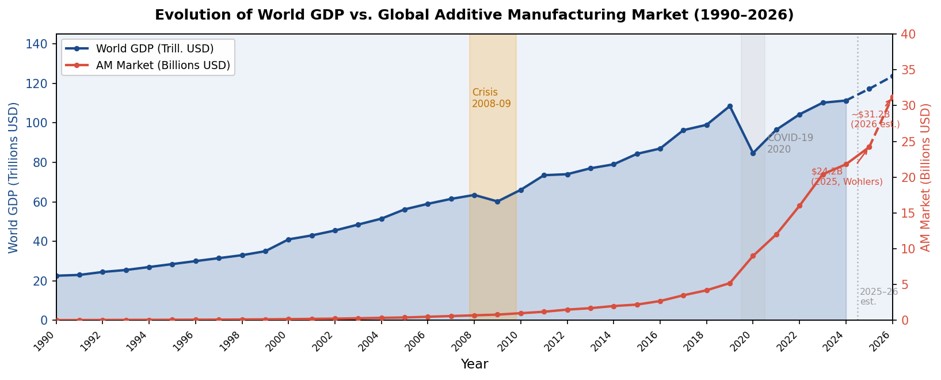
3D printing, or Additive Manufacturing (AM), has evolved from a specialised tool for creating prototypes into a large international marketplace valued at $24.2 billion in 2025. In this study, we investigated how the size of the additive manufacturing marketplace is connected to global economic activity, as measured by Gross Domestic Product (GDP). We documented a nearly 807-fold increase in the additive manufacturing marketplace, compared with a 5.2-fold increase in World GDP over the same period. We document four distinct periods of growth in the additive manufacturing marketplace and demonstrate that investments in AM have been uncorrelated with most major economic recessions, including those caused by the 2008–2009 financial crisis and the COVID-19 pandemic. The three principal mechanisms through which additive manufacturing has contributed to economic growth are increased total factor productivity, the creation of new markets and business models based on distributed manufacturing, and improved supply chain resilience. A dramatic decline in the cost of additive manufacturing equipment – that occurred approximately 1,250 times faster than traditional two-dimensional printing –was identified as the primary structural cause of the rapid expansion of the additive manufacturing market. These results were framed through the lens of cognitive sustainability, which views digital manufacturing technologies as enabling humans to produce more efficiently by utilising fewer resources. The findings indicate that additive manufacturing provides a cognitively sustainable pathway to technological innovation with broad implications for long-term economic development, industrial policies and green transition strategies.
References
DSourced (2024). The Complete History of 3D Printing: From 1980 to 2024. URL: https://www.3dsourced.com/guides/history-of-3d-printing/
All3DP (2025). What Is the Price of a Metal 3D Printer These Days? URL: https://all3dp.com/2/how-much-does-a-metal-3d-printer-cost/
Alzyod, H., Ficzere, P., & Borbas, L. (2024). Cost-efficient additive manufacturing: Unraveling the economic dynamics of material Extrusion (MEX) technology. International Review, (3-4):185-196. URL:https://www.ceeol.com/search/article-detail?id=1296018
AM Research. (2024). Additive Manufacturing for Military and Defense Report. AM Research. URL: https://additivemanufacturingresearch.com/reports/additive-manufacturing-for-military-and-defense-market-analysis-and-forecast/
Eurostat (2024). ICT Usage in Enterprises Survey – Digital Intensity Index. European Commission. URL: https://ec.europa.eu/eurostat/cache/metadata/en/isoc_e_esms.htm
Ficzere, P. (2022). The impact of the positioning of parts on the variable production costs in the case of additive manufacturing. Periodica Polytechnica Transportation Engineering, 50(3), 304-308. DOI: https://doi.org/10.3311/PPtr.15827
Freund, C., Mulabdic, A., Ruta, M. (2020). Is 3D Printing a Threat to Global Trade? The Trade Effects You Didn’t Hear About. Policy Research Working Paper 9024. World Bank. URL: https://documents1.worldbank.org
GE Aviation (2024). LEAP Engine Product Overview. General Electric. URL: https://www.geaerospace.com
Grand View Research (2025). Additive Manufacturing Market Size, Share & Trends Analysis Report. URL: https://www.grandviewresearch.com/industry-analysis/additive-manufacturing-market
Horváth Á. M., Ficzere, P. (2015). Rapid prototyping in medical sciences. Production Engineering Archives. 8(3):28-34
IMF (2025). World Economic Outlook, October 2025. International Monetary Fund. URL: https://www.imf.org/en/publications/weo/issues/2025/10/14/world-economic-outlook-october-2025
IMF (2026). World Economic Outlook, April 2026. International Monetary Fund. URL: https://www.imf.org/external/datamapper/NGDPD@WEO/WEOWORLD
Javaid, M., Haleem, A. (2020). Critical components of Industry 5.0 towards a successful adoption in the field of manufacturing. Journal of Industrial Integration and Management. 5(3), 327–348. DOI: 10.1142/S2424862220500141
Jung, S., Kara, L. B., Nie, Z., Simpson, T. W., Whitefoot, K. S. (2023). Is additive manufacturing an environmentally and economically preferred alternative for mass production? Environmental Science & Technology. 57(16), 6373–6386. DOI: 10.1021/acs.est.2c04927
McKinsey Global Institute. (2019). The future of work: Reskilling imperatives and workforce transitions in the automation era. McKinsey & Company URL: https://www.mckinsey.com/~/media/McKinsey/Business%20Functions/McKinsey%20Digital/Our%20Insights/The%20future%20of%20work%20Reskilling%20and%20Remote%20working%20to%20recover%20in%20the%20Next%20Normal/The-future-of-work-Reskilling-and-remote-working-to-recover-in-the-next-normal-vF.pdf
Niaki, M. K., Nonino, F. (2017). Impact of additive manufacturing on business competitiveness: A multiple case study. Journal of Manufacturing Technology Management. 28(1): 56–74. DOI: 10.1108/JMTM-01-2016-0001
Unionfab (2023). 3D Printing Cost and Speed: Trace the Evolution and Calculate with Unionfab. URL: https://www.unionfab.com/blog/2023/07/3d-printing-cost-and-speed
Wohlers Associates / ASTM International (2024). Wohlers Report 2024. URL: https://wohlersassociates.com/product/wr2024/
Wohlers Associates / ASTM International (2025). Wohlers Report 2025. URL: https://wohlersassociates.com/product/wr2025/
Wohlers Associates / ASTM International (2026). Wohlers Report 2026. URL: https://platform.wohlersassociates.com/insights/wohlers-report-2026
World Bank (2025). World Development Indicators – GDP (current US$), series NY.GDP.MKTP.CD. URL: https://data.worldbank.org/indicator/NY.GDP.MKTP.CD
Zöldy, M., Szalmáné Csete, M., Kolozsi, P. P., Bordás, P., Torok, A. (2022). Cognitive Sustainability. Cognitive Sustainability. 1(1), 3–9. DOI: https://doi.org/10.55343/CogSust.7