Persistent Core–Periphery Innovation Dynamics in Italy: Evidence against Long-Run Convergence
Abstract
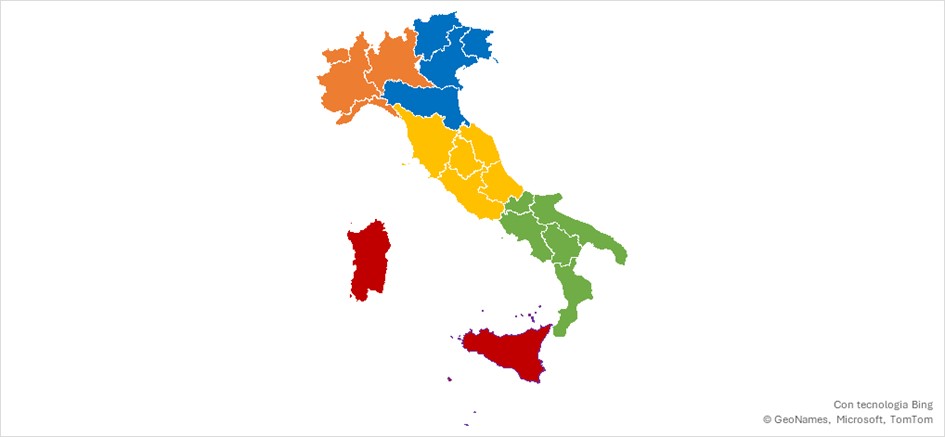
This study investigates the relationship between economic growth, agglomeration, and innovation within the framework of endogenous growth theory and economic geography. Building on Philippe Martin's theoretical approach, the paper examines how the spatial concentration of economic activities influences innovation dynamics and regional development. The study pursues two main objectives: first, to measure the spatial distribution of innovation across Italian regions; second, to assess whether regional dynamics between 2021 and 2023 indicate convergence or confirm the persistence of core–periphery asymmetries. The empirical analysis uses national and macro-regional data from Eurostat, including GDP at current market prices, a measure of agglomeration, and Gross Domestic Expenditure on Research and Development (GERD) as a proxy for innovation intensity. The relationships among these variables are explored through descriptive and graphical analysis, as well as convergence tests and spatial autocorrelation analysis. The results show that, although Italy experienced economic growth and a moderate increase in agglomeration during the period under consideration, innovation intensity remained largely stagnant. Significant regional disparities persist, with the Northern and Central regions maintaining higher innovation levels than Southern Italy and the Islands. Overall, the findings suggest that recent regional dynamics show only limited signs of convergence, while confirming the persistence of a core–periphery spatial structure in the Italian economy.
References
Anselin, L., Varga, A., Acs, Z. (1997). Local geographic spillovers between university research and high-technology innovations. Journal of Urban Economics, 42(3), 422–448. DOI: https://doi.org/10.1006/juec.1997.2032
Arrow, K. J. (1962). The economic implications of learning by doing. Review of Economic Studies. 29(3), 155–173. DOI: https://doi.org/10.2307/2295952
Audretsch, D. B., Feldman, M. P. (1996). R&D spillovers and the geography of innovation and production. American Economic Review. 86(3), 630–640. URL: https://www.jstor.org/stable/2118216
Baldwin, R. E., Martin, P., Ottaviano, G. I. P. (2001). Global income divergence, trade and industrialisation: The geography of growth take-offs. Journal of Economic Growth. 6(1), 5–37. DOI: https://doi.org/10.1023/A:1009876310544
Boldizsár, A. (2024). The European Union's global goods transport and trade relations and their implications. Periodica Polytechnica Transportation Engineering. 52(4), 382–387. DOI: https://doi.org/10.3311/PPtr.25681
Esses, D., Szalmáné Csete, M. (2022). Reconceptualising regional inequalities: The application of a modified Philippe Martin model to the tourism sector. Periodica Polytechnica Social and Management Sciences. 31(1). DOI: https://doi.org/10.3311/PPso.17329
European Union (2024) NextGenerationEU, URL: https://next-generation-eu.europa.eu/recovery-and-resilience-facility_en
European Union (2025) Italy's recovery and resilience plan. URL: https://reforms-investments.ec.europa.eu/italys-recovery-and-resilience-plan_en#annual-events
Eurostat (2024a). Enterprises by NUTS 1 region and NACE Rev. 2 activity. Eurostat Database, European Commission. URL: https://ec.europa.eu/eurostat/databrowser/view/sbs_r_nuts2021/default/table?lang=EN
Eurostat (2024b). GERD (Gross domestic expenditure on R&D) by sector of performance and NUTS 1 region. Eurostat Database, European Commission. URL: https://ec.europa.eu/eurostat/databrowser/view/rd_e_gerdtot/default/table?lang=en
Eurostat (2024c). Gross domestic product (GDP) at current market prices by NUTS 1 region. Eurostat Database, European Commission. URL: https://ec.europa.eu/eurostat/databrowser/view/TEC00001/default/table
Fadeev, A., Alhusseini, S. (2023). Determination of urban public transport demand by processing electronic travel ticket data. Periodica Polytechnica Transportation Engineering, 51(4), 394–408. DOI: https://doi.org/10.3311/PPtr.21447
Fujita, M., Krugman, P., Venables, A. J. (1999). The Spatial Economy: Cities, Regions and International Trade. MIT Press. DOI: https://doi.org/10.7551/mitpress/6389.001.0001
Fujita, M., Thisse, J. F. (2002). Economics of Agglomeration: Cities, Industrial Location and Regional Growth. Cambridge University Press. 1–22. DOI: https://doi.org/10.1017/CBO9780511805660.001
ISTAT (2024). Italy in Figures 2024. Italian National Institute of Statistics, Rome. URL: https://esploradati.istat.it/databrowser/#/en/dw/categories
Jaber, A., Hamadneh, J. (2024). Demographic analysis of active transport mode users in urban context. Periodica Polytechnica Transportation Engineering, 52(4), 326–332. DOI: https://doi.org/10.3311/PPtr.23401
Jaffe, A. B. (1989). Real effects of academic research. American Economic Review. 79(5), 957–970. URL: https://www.jstor.org/stable/1831431
Juhász, M., Mátrai, T. (2024). Comprehensive sensitivity analysis of cost-benefit analysis variables for transport interventions. Promet – Traffic and Transportation. 36(4). DOI: https://doi.org/10.7307/ptt.v36i4.529
Krugman, P. (1980). Scale economies, product differentiation, and the pattern of trade. American Economic Review. 70(5), 950–959. URL: https://www.jstor.org/stable/1805774
Krugman, P. (1991). Increasing returns and economic geography. Journal of Political Economy. 99(3), 483–499. DOI: https://doi.org/10.1086/261763
Krugman, P. (1993). On the relationship between trade theory and location theory. Review of International Economics. 1(2), 110–122. DOI: https://doi.org/10.1111/j.1467-9396.1993.tb00009.x
Lucas, R. E. (1988). On the mechanics of economic development. Journal of Monetary Economics, 22(1), 3–42. DOI: https://doi.org/10.1016/0304-3932(88)90168-7
Macsinka, K. (2025). Mobility impacts of urban development in the agglomeration. Acta Technica Jaurinensis. 18(4). DOI: https://doi.org/10.14513/actatechjaur.00782
Martin, P. (1998). Can regional policies affect growth and geography in Europe? The World Economy. 21(6), 757–774. DOI: https://doi.org/10.1111/1467-9701.00162
Martin, P. (1999a). Are European regional policies delivering? Sciences Po Economics Publications Working Paper. HAL Open Archive. URL: https://sciencespo.hal.science/hal-01011168
Martin, P. (1999b). Public policies, regional inequalities and growth. Journal of Public Economics. 73(1), 85–105. DOI: https://doi.org/10.1016/S0047-2727(98)00110-8
Martin, P., Mayer, T., Mayneris, F. (2011). Spatial concentration and plant-level productivity in France. Journal of Urban Economics. 69(2), 182–195. DOI: https://doi.org/10.1016/j.jue.2010.09.002
Martin, P., Ottaviano, G. I. P. (1999). Growing locations: Industry location in a model of endogenous growth. European Economic Review. 43(2), 281–302. DOI: https://doi.org/10.1016/S0014-2921(98)00031-2
Ötvös, V. (2025). The two sides of the coin of externality in road transport. Acta Technica Jaurinensis. 18(3). DOI: http://doi.org/10.14513/actatechjaur.00773
Pastuszka, S. (2017). Regional differentiation of the demographic potential in Italy and Poland. Comparative Economic Research. Central and Eastern Europe, 20(3), 137-159. DOI: https://doi.org/10.1515/cer-2017-0024
Petrović, N., Jovanović, V., Marković, S., Marinković, D., Nikolić, B. (2025). Multi-criteria decision-making approach for choosing e-bus for urban public transport in the city of Niš.Acta Technica Jaurinensis, 18(1). DOI: https://doi.org/10.14513/actatechjaur.00758
Prusov, D., Dubova, S. (2022). Modeling of passenger flows in agglomerations of large developing cities (on the example of Kyiv). Periodica Polytechnica Transportation Engineering. 5(4). DOI: https://doi.org/10.3311/PPtr.19785
Romer, P. M. (1986). Increasing returns and long-run growth. Journal of Political Economy. 94(5), 1002–1037. DOI: https://doi.org/10.1086/261420
Romer, P. M. (1990). Endogenous technological change. Journal of Political Economy. 98(5), S71–S102. DOI: https://doi.org/10.1086/261725
Sahin, S. N. A. (2023). A systematic overview of decision-making on public transport systems using bibliometric analysis on VOSviewer. Transport and Telecommunication Journal, 24(4). DOI: https://doi.org/10.2478/ttj-2023-0036
Škorupa, M., Bulková, Z., Gašparík, J., Kendra, M. (2024). Methodology for designing a system of public passenger transport in a functional region. Periodica Polytechnica Transportation Engineering. 52(1). DOI: https://doi.org/10.3311/PPtr.23159
Solow, R. M. (1956). A contribution to the theory of economic growth. Quarterly Journal of Economics. 70(1), 65–94. DOI: https://doi.org/10.2307/1884513
Szalmáné Csete, M., Baranyi, T. (2023). Can smart city planning enhance the sustainable transition of the EU capitals? A project and strategy-based smart, sustainable performance analysis in the programming period 2014–2020. Production Engineering Archives. 29(4). DOI: https://doi.org/10.30657/pea.2023.29.51
Szendi, D. (2024). Testing the validity of spatial beta convergence for the countries of Southern Europe. Review of Business & Management – Theory, Management, Practice (TMP). 20(2), 55–67. DOI: https://doi.org/10.18096/TMP.2024.02.04
Van Leeuwen, E. (2015). Urban-rural synergies: An explorative study at the NUTS3 level. Applied Spatial Analysis and Policy. 8(3), 273–289. DOI: https://doi.org/10.1007/s12061-015-9167-x
Wang, Q., Yu, W., Wang, W., Hua, X. (2022). Towards intercity mobility system: Insights into the spatial interaction gravity model and determination approach. Promet-Traffic & Transportation. DOI: https://doi.org/10.7307/ptt.v36i2.414
World Bank (2024). World Development Indicators: Italy. World Bank Database. URL: https://data.worldbank.org/country/italy
Zheng, Z., Liu, Y., Zhou, Y., & Chen, T. (2026). Navigating from Spatial Heterogeneity to Synergistic Convergence: The Dynamics of Innovation Efficiency in China's Regional Innovation Ecosystems. International Review of Economics & Finance, 104933. DOI: https://doi.org/10.1016/j.iref.2026.104933
Zöldy, M. (2024). Changes at mobility space use in the cognitive mobility era. Acta Technica Jaurinensis, 17(4). DOI: https://doi.org/10.14513/actatechjaur.00750