Safety Management Systems in Road Transport: Opportunities and Challenges in Shared Mobility
Abstract
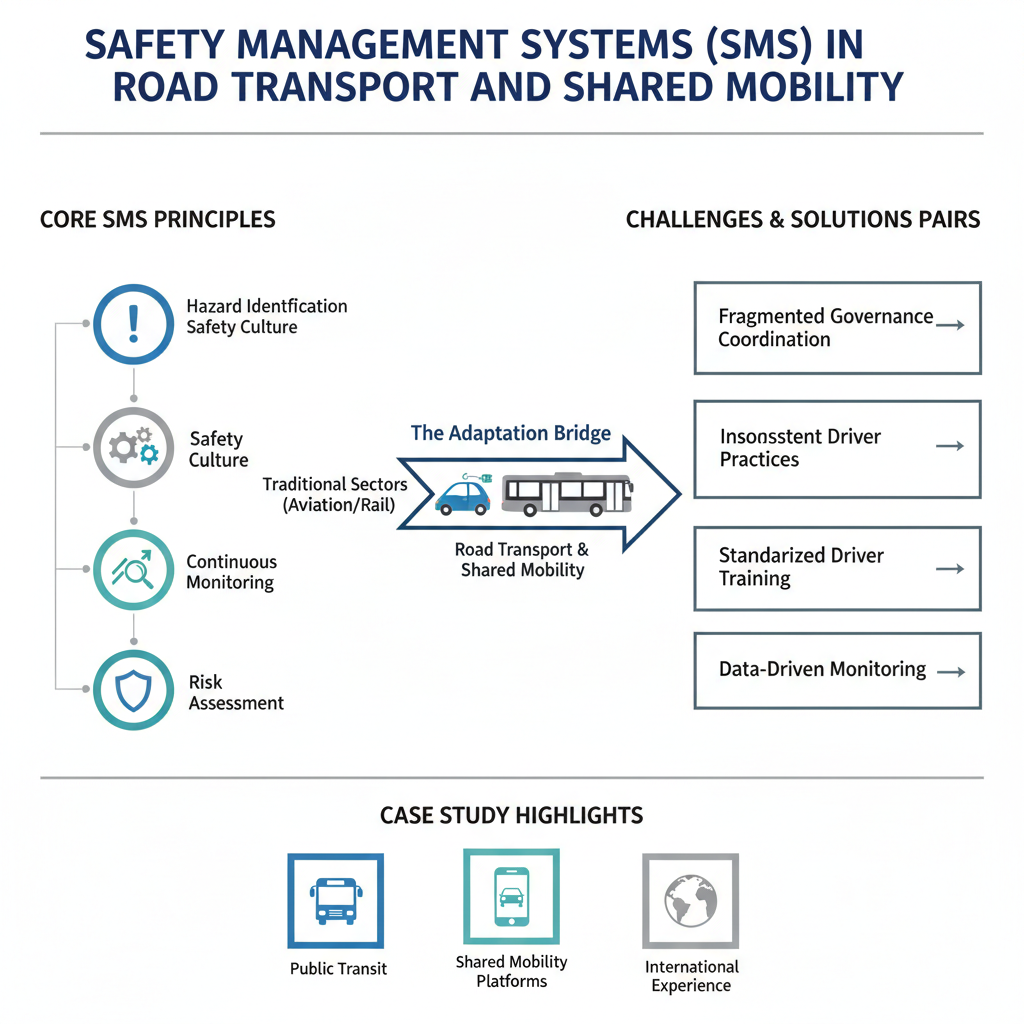
Safety Management Systems (SMS) have long been applied in high-risk sectors such as aviation and rail, but their adaptation to road transport remains underexplored. This paper examines the potential of SMS as a proactive framework for improving safety in road transport, with particular attention to shared auto vehicles. It traces the origins and principles of SMS, evaluates its benefits and limitations, and analyzes case studies from public transit, shared mobility platforms, and international experiences. The findings show that SMS can strengthen safety culture, enhance hazard identification, and support continuous monitoring, yet challenges such as fragmented governance, inconsistent driver practices, and technological barriers limit its effectiveness. The paper argues that stronger policy commitment, regulatory oversight, and institutional coordination are essential for successful implementation, alongside platform-level measures such as driver training, fatigue management, and data-driven monitoring. The distinctive contribution of this study lies in extending SMS from traditional high-risk sectors to the fragmented and rapidly evolving context of road transport and shared mobility, clarifying both the opportunities and systemic challenges of such adaptation for policymakers, regulators, and platform operators.
References
ACI (2016). ACI SMS Handbook. Airports Council International – ACI World, Montréal, Canada. URL: https://fliphtml5.com/bjvah/kiet/2016_ACI_SMS_Handbook_WEB_FINAL/6/
Adikwu, F. E. , Esiri, A. E. , Aderamo, A. T. , Akano, O. A. , Erhueh, O. V. (2024). Leveraging digital technologies for health, safety, and environmental (HSE) management in industrial operations. International Journal of Applied Research in Social Sciences. 6(11), 2712–2726. DOI: 10.51594/ijarss.v6i11.1722
Afifudin, M., Rahman, R. T., Bahar, A., Prananta, A. W. (2024). Driver safety protocols, emergency response systems, insurance coverage, and customer feedback on service quality in Indonesia’s ride-hailing industry. International Journal of Business, Law, and Education. 5(2), 2584–2595. DOI: 10.56442/ijble.v5i2.903
Agarwal, P. K., Kumar, P., Singh, H. (2020). Causes and factors in road traffic accidents at a tertiary care center of Western Uttar Pradesh. Medico Legal Update. 20(1), 38–41. DOI: 10.37506/mlu.v20i1.321
Al-Mahamid, H. (2025). A comparative analysis of the human development index and road safety outcomes in the European Union. European Transport Studies. 2, 100041. DOI: 10.1016/j.ets.2025.100041
Al-Mahamid, H., Al-Nabulsi, D., Torok, A. (2025). Developing safety performance functions incorporating pavement roughness using Poisson regression and Machine learning models on Jordan’s Desert Highway. Transportation Research Interdisciplinary Perspectives. 34, 101659. DOI: 10.1016/j.trip.2025.101659
Anderson, D. (2003). Implementing Safety Management Systems (Stakeholder Alignment). URL: https://www.transportationgroup.nz/papers/2003/05_Denise_Anderson.pdf
Bates, L., Watson, B., King, M. J. (2010). Mobility and safety are conflicting goals for transport policy makers when making decisions about graduated driver licensing. International Journal of Health Promotion and Education. 48(2), 46–51. DOI: 10.1080/14635240.2010.10708181
Čabarkapa, M., Brčić, D., Vešović, V. (2016). Development of Strategic Goals of Road Safety Management: A Case Study of Montenegro. Promet – Traffic & Transportation. 28(6), 651–660. DOI: 7307/ptt.v28i6.2112
Chapelon, J., Lassarre, S. (2010). Road safety in France: The hard path toward science-based policy. Safety Science. 48(9), 1151–1159. DOI: 10.1016/J.SSCI.2010.04.015
Cieśla, M., Sobota, A., Jacyna, M. (2020). Multi-criteria decision making process in metropolitan transport means selection based on the sharing mobility idea. Sustainability. 12(17), 7231. DOI: 10.3390/su12177231
ERA – European Union Agency for Railways (2022). Safety management system requirements for safety certification or safety authorisation. Publications Office, Luxemburg. URL: https://www.era.europa.eu/system/files/2022-11/Guide%20on%20safety%20management%20system%20requirements.pdf
FTA – Federal Transit Administration (2018). Public Transportation Agency Safety Plans. Federal Transit Administration. URL: https://www.transit.dot.gov/PTASP (accessed 9.23.25).
FTA – Federal Transit Administration (2020). Safety Management Systems (SMS) Information, Approaches and Best Practices. Federal Transit Administration. URL: https://www.transit.dot.gov/regulations-and-guidance/safety/safety-management-systems-sms-information-approaches-and-best (accessed 9.21.25).
Fu, F., Cai, Z., Jin, S., Xu, C. (2024). Monitoring ride‐hailing passenger security risk: An approach using human geography data. IET Intelligent Transport Systems. 19(1), e12601. https://doi.org/10.1049/itr2.12601
Geoffroy, D. N. (1993). A management perspective on developing and implementing safety management systems. Transportation Research Circular. 416, TRB, National Research Council, Washington, D.C. 8–16. URL: https://onlinepubs.trb.org/Onlinepubs/trcircular/416/416-002.pdf
Hollnagel, E., Wears, R., Braithwaite, J. (2015). From Safety-I to Safety-II: A White Paper. URL https://www.researchgate.net/publication/282441875_From_Safety-I_to_Safety-II_A_White_Paper (accessed 9.21.25).
Hou, H., Guan, Z. (2020). Evaluation of Safety Awareness of Ride-Hailing Drivers in China. CICTP 2020. DOI: 10.1061/9780784482933.371
IATA – International Air Transport Association (n.d.). Safety Management System. URL https://www.iata.org/en/programs/safety/safety-management-system/ (accessed 9.21.25).
ICAO – International Civil Aviation Organization (2013). The Postal History of ICAO. Annex 19 – Safety Management. URL: https://www.icao.int/sites/default/files/postalhistory/annex_19_safety_management.htm (accessed 9.21.25).
Kelly, T. (2017). The role of the regulator in SMS. International Transport Forum Discussion Papers. 2017/17, OECD Publishing, Paris. DOI: 10.1787/011DB79B-EN
Khan, M. N., Das, S. (2024). Advancing traffic safety through the safe system approach: A systematic review. Accident Analysis & Prevention. 199, 107518. DOI: 10.1016/j.aap.2024.107518
Lappalainen, J. (2017). Overcoming obstacles to implementing SMS. International Transport Forum Discussion Papers. 2017/18, OECD Publishing, Paris. DOI: 10.1787/0564329c-en
Lefcoe, A. D., Connelly, C., Gellatly, I. R. (2023). Ride-hail drivers, taxi drivers and multiple jobholders: Who takes the most risks and why? Work, Employment and Society. 38(5), 1307–1332. DOI: 10.1177/09500170231185212
Lu, Y., Zhang, J., Qi, Y., Qi, S., Li, Y., Song, H., Liu, Y. (2023). Safety warning! Decentralised and automated incentives for disqualified drivers auditing in ride-hailing services. IEEE Transactions on Mobile Computing. 22(3), 1748–1762. DOI: 10.1109/TMC.2021.3108012
MacEachen, E., Musson, E. R., Bartel, E., Carrière, J., Meyer, S. B., Varatharajan, S., Kosny, A., Bigelow, P., Saunders, R. (2018). 284 Safety management systems: Peer-to-peer ratings in the sharing economy. Occupational & Environmental Medicine. 75(Suppl. 2), 516–516. DOI: 10.1136/oemed-2018-ICOHabstracts.1463
Mahudin, N. D. M., Sakiman, M. N. (2018). A tale of two hailings: driving behaviour and safety culture perceptions according to driver types and working hours. The 2nd Conference of ASEAN Road Safety 2018 (CARS2018), 4th-6th December 2018, Subang Jaya, Selangor. URL: http://irep.iium.edu.my/69630/
Malomane, R., Musonda, I., Okoro, C. S. (2022). The opportunities and challenges associated with the implementation of fourth industrial revolution technologies to manage health and safety. International Journal of Environmental Research and Public Health. 19(2), 846. DOI: 10.3390/ijerph19020846
Mao, H., Deng, X., Jiang, H., Shi, L., Li, H., Tuo, L., Shi, D., Guo, F. (2021). Driving safety assessment for ride-hailing drivers. Accident Analysis & Prevention. 149, 105574. DOI: 10.1016/j.aap.2020.105574
Mauriño, D., 2017. Why SMS?: An Introduction and Overview of Safety Management Systems (SMS). International Transport Forum Discussion Papers. 2017/16, OECD Publishing, Paris. DOI: 10.1787/31EBB8A3-EN
May, M., Tranter, P. J., Warn, J. R. (2011). Progressing road safety through deep change and transformational leadership. Journal of Transport Geography. 19(6), 1423–1430. DOI: 10.1016/j.jtrangeo.2011.07.002
Mooren, L., Shuey, R. (2024). Systems Thinking in Road Safety Management. Journal of Road Safety. 35(2), 63–73. DOI: 10.33492/jrs-d-24-2-2109985
Mueller, J., Zheng, W., Schnieder, E. (2010). The improvement of the safety-case process in practice: From problems and a promising approach to highly automated safety case guidance. WIT Transactions on The Built Environment. 114, 795–803. DOI: 10.2495/CR100721
Muhlrad, N. (2006). Road safety and other policies : conflict or integration. ICTCT Workshop, Minsk, 2006. URL: https://www.ictct.net/wp-content/uploads/19-Minsk-2006/19-Muhlrad-Full-paper.pdf
Nævestad, T.-O., Elvebakk, B., Ranestad, K. (2021). Work-related accident prevention in Norwegian road and maritime transport: Examining the influence of different sector rules. Infrastructures. 6(5), 72. DOI: 10.3390/infrastructures6050072
Nedeliaková, E., Hranický, M. P., Valla, M. (2022). Risk identification methodology regarding the safety and quality of railway services. Production Engineering Archives. 28(1), 21–29. DOI: 10.30657/pea.2022.28.03
Nguyen, H., Taneerananon, P., Koren, C., Iamtrakul, P. (2013). The significance of developing a new black spot safety management approach for the local road traffic nature of Ho Chi Minh City. Acta Technica Jaurinensis. 6(2), 91–106. URL: https://acta.sze.hu/index.php/acta/article/view/53
Niu, H., Zhu, H., Sun, Y., Lu, X., Sun, J., Zhao, Z., Xiong, H., Lang, B. (2021). Exploring the risky travel area and behavior of car-hailing service. ACM Transactions on Intelligent Systems and Technology (TIST). 13(1), 1–22. DOI: 10.1145/3465059
NTSB – National Transportation Safety Board (2023). Safety Management Systems. National Transportation Safety Board. URL: https://www.ntsb.gov/Advocacy/mwl/Pages/mwl-3.aspx (accessed 9.21.25).
OECD/ITF – International Transport Forum (2018). Safety Management Systems: Summary and Conclusions. ITF Roundtable Reports. 172. OECD Publishing, Paris. DOI: 10.1787/d5fda9c4-en.
Pembuain, A., Priyanto, S., Suparma, L. (2019). The effect of road infrastructure on traffic accidents. 11th Asia Pacific Transportation and the Environment Conference (APTE 2018), Atlantis Press. 176–182. DOI: 10.2991/apte-18.2019.27
Prabowo, E. F., Isbah, M. F. (2022). Algorithmic exploitation: Understanding labor process and control among ride- hailing platform workers. Jurnal Sosioteknologi. 21(2). DOI: 10.5614/sostek.itbj.2022.21.2.5
Reason, J. (1997). Managing the Risks of Organisational Accidents. Routledge, London. DOI: 10.4324/9781315543543
Regulation (EU) 2018/762 – Commission Delegated Regulation (EU) 2018/762 of 8 March 2018 establishing common safety methods on safety management system requirements pursuant to Directive (EU) 2016/798 of the European Parliament and of the Council and repealing Commission Regulations (EU) No 1158/2010 and (EU) No 1169/2010
Ren, Y.-H. (2013). Analysis of road traffic accident caused by human error. ICTIS 2013: Improving Multimodal Transportation Systems-Information, Safety, and Integration. 547–552. DOI: 10.1061/9780784413036.073
Sakhapov, R., Nikolaeva, R. (2018). Traffic safety system management. Transportation Research Procedia. 36, 676–681. DOI: 10.1016/j.trpro.2018.12.126
Singh, H., Kushwaha, V., Agarwal, A. D., Sandhu, S. S. (2016). Fatal road traffic accidents: Causes and factors responsible. Journal of Indian Academy of Forensic Medicine. 38, 52–54. DOI: 10.5958/0974-0848.2016.00014.2
Spencer, L., Caton, J., Mauriño, D., Lazaro, R. (2015). FTA Safety Management Systems. SMS Framework. FTA. URL: https://wisconsindot.gov/Documents/doing-bus/local-gov/astnce-pgms/transit/compliance/tran-sms.pdf
Steiner, S., Gradišar, T., Smrečki, B. (2009). Problems of SMS Implementation in Transition. Proceedings of 21st annual European Aviation Safety Seminar. URL: https://www.croris.hr/crosbi/publikacija/prilog-skup/546211
Stolzer, A. J. (2008). Safety Management Systems in Aviation. Routledge, London. https://doi.org/10.4324/9781351149648
Stoma, M., Caban, J., Dudziak, A., Kuranc, A. (2021). Selected Aspects of the Road Traffic Safety Management System. Communications. 23(2): F33–F42.DOI: 10.26552/COM.C.2021.2.F33-F42
Teske, B .E., Adjekum, D. K. (2021). Advancements in space safety: An assessment of Safety Management System Theory (SMST) Attributes among commercial space organisations and CFR Part 121 Airlines. Journal of Space Safety Engineering. 8(4), 266–275. DOI: doi.org/10.1016/j.jsse.2021.10.001
Teusch, J., Gremmel, J. N., Koetsier, C., Johora, F., Sester, M., Woisetschläger, D. M., Müller, J. P. (2023). A systematic literature review on machine learning in shared mobility. IEEE Open Journal of Intelligent Transportation Systems. 4, 870–899. DOI: 10.1109/OJITS.2023.3334393
Tong, W., Dong, X., Yang, W., Shen, Y., Yang, C., Dong, Z. (2024). Non-subjective trust mechanism for online ride-hailing services. IEEE International Conference on Web Services (ICWS). 1377–1383. DOI: 10.1109/ICWS62655.2024.00174
Turner, J. (2012). Urban mass transit, gender planning protocols and social sustainability: The case of Jakarta. Research in Transportation Economics. 34(1), 48–53. DOI: 10.1016/J.RETREC.2011.12.003
United Nations (2015). Sustainable Development Goals URL: https://sdgs.un.org/
WHO – World Health Organization (2023). Global Status Report on Road Safety. World Health Organization. URL: https://www.who.int/teams/social-determinants-of-health/safety-and-mobility/global-status-report-on-road-safety-2023 (accessed 9.21.25).
Zang, H., Li, M., Jin, Z., Huang, J. (2025). Unveiling construction accident causation: A scientometric analysis and qualitative review of research trends. Frontiers in Built Environment. 11. DOI: 10.3389/fbuil.2025.1602297
Zhang, J., Li, L., Pan, Y., Qu, X., Ran, B. (2025). Chinese ride-hailing drivers’ adoption intention of new risk visualisation system: A questionnaire analysis based on the improved UTAUT2 Model. SAE Technical Paper. 2025-01-7122. DOI: 10.4271/2025-01-7122