Politics of knowledge: A questionable legal innovation
Abstract
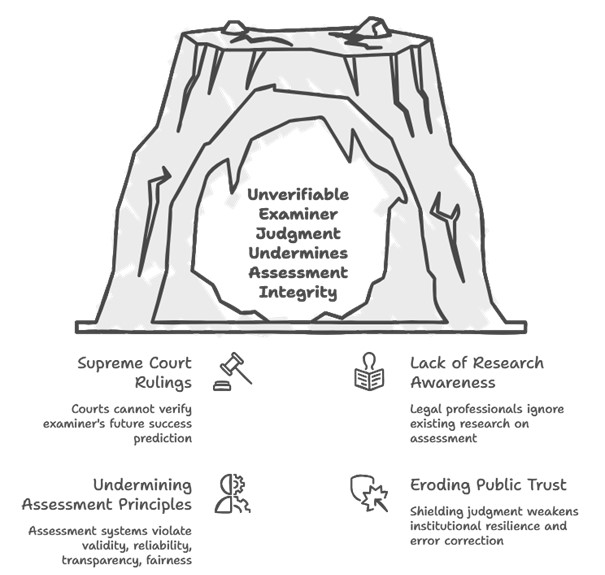
German legal practitioners have tried to address complaints about professional exams. Two Supreme Court rulings suggest that a prediction of a candidate's future success in a professional examination cannot be verified or rebutted by a court or anyone else, but only by the individual examiner. In contrast to the apparent understanding of legal professionals, this type of knowledge is not an "unknown territory"; it is traditionally covered in research, e.g., in psychology or human resource management. It also undermines internationally recognised principles of sound assessment governance, such as validity, reliability, transparency, and fairness, as emphasised in UNESCO's global guidance on learning assessments and in OECD frameworks for evaluation and quality assurance in education systems. Situating these issues within a broader sustainability perspective, this paper argues that assessment regimes form part of society's knowledge infrastructure, and their integrity is essential for both cognitive sustainability – the long‑term capacity of institutions to maintain transparent, evidence‑based and error‑correcting knowledge practices – and for the realisation of Sustainable Development Goals. In particular, SDG 4 (Quality Education) requires equitable, valid and reliable assessment mechanisms as a foundation of fair and merit‑based professional pathways. At the same time, SDG 16 (Peace, Justice and Strong Institutions) calls for accountable, transparent and trustworthy institutional processes in all sectors, including regulated professions. Assessment systems that shield examiner judgment from external scrutiny impede these sustainability commitments by eroding public trust, weakening institutional resilience, and preventing the correction of systematic errors. This paper draws on a range of disciplines to highlight the decisions and errors made in practice. In addition, an International Education standard by the International Federation of Accountants (IFAC) is used to contrast findings. The paper thereby contributes to cognitive sustainability by examining how assessment systems can either sustain or undermine the long‑term resilience and transparency of societal knowledge practices.
References
Antoni, C. (2003). Teamarbeit. In: Auhagen, A. E., Bierhoff, W. (Hrsg.). Angewandte Sozialpsychologie – Das Praxishandbuch. Beltz, Weinheim. 351–365.
Baetge, J., Kirsch, H.-J., Thiele, S. (2004). Bilanzanalyse. 2. Auflage. Düsseldorf, IDW-Verlag.
Bernecker, S., Dretske, F. (eds). 2000. Knowledge. Readings in Contemporary Epistemology. Oxford University Press, Oxford. 13–15.
Chapman, G. B., Johnson, E. J. (2002). Incorporating the Irrelevant: Anchors in Judgment of Beliefs and Value. In: Gilovich, T., Griffin, D., Kahneman, D. (eds). Heuristics and Biases: The Psychology of Intuitive Judgement. Cambridge University Press, Cambridge, UK. 120–138. DOI: https://doi.org/10.1017/CBO9780511808098.008
Cohen, W. M., & Levinthal, D. A. (1990). Absorptive capacity: A new perspective on learning and innovation. Administrative science quarterly, 35(1), 128-152. URL: https://josephmahoney.web.illinois.edu/BA545_Fall%202022/Cohen%20and%20Levinthal%20(1990).pdf
De Bondt, W. F. M., Thaler, R. H. (1987). Further evidence on investor overreaction and stock market seasonality. The Journal of Finance. 42(3), 557–581. DOI: https://doi.org/10.1111/j.1540-6261.1987.tb04569.x
Fischer, E, Jeremias, C., Dieterich, P. (2026). Prüfungsrecht, 9th edition. C. H. Beck, München.
Garud, R., Karnøe, P. (eds) (2001). Path dependence and creation. Erlbaum, Mahwah, NJ.
Goldstein, J. E., Neimark, B., Garvey, B., Phelps, J. (2023). Unlocking "lock-in" and path dependency: A review across disciplines and socio-environmental contexts. World Development. 161, 106116. DOI: https://doi.org/10.1016/j.worlddev.2022.106116
Horwich, Paul. (1998). Truth. 2nd edition. Oxford University Press, Oxford.
Humphrey, C. (1997). Debating Audit Expectations. In: Sherer, M., Turley, S. (eds). Current Issues in Auditing. Paul Chapman, London.
IFAC (2025). International Education Standard 6. IFAC (International Federation of Accountants). URL: https://www.ifac.org/publications/international-education-standard-6-initial-professional-development-formal-assessment-professional or https://ifacweb.blob.core.windows.net/publicfiles/2025-03/IFAC-International-Education-Standard-6-Assessment.pdf (as of March 2025)
Kahneman, D., Tversky, A. (1972). Subjective probability: A judgment of representativeness. Cognitive Psychology. 3(3). 430–454. DOI: https://doi.org/10.1016/0010-0285(72)90016-3
Intuitive Judgement. Cambridge University Press, Cambridge, UK. 686–715. DOI: https://doi.org/10.1017/CBO9780511808098.041
Kühnel, S. (2004). Wissensorganisation in Professional Service Firms: Perspektiven aus der Wirtschaftsprüfung. Dissertation, Universität St. Gallen.
Moreno-Casas, V. (2024). A coevolutionary approach to institutional lock‐in. Review of Evolutionary Political Economy. 5. 495–509. DOI: https://doi.org/10.1007/s43253-024-00132-2
Moser, P. K., Mulder, D. H., Trout, J. D. (eds) (1998). The theory of knowledge – A thematic introduction. Oxford University Press, Oxford.
Pohl, R. F. (1992). Der Rückschau-Fehler: Systematische Verfälschung der Erinnerung bei Experten und Novizen. Kognitionswissenschaft. 3. 38–44.
Ryle, G. (1949). Concept of mind. Hutchinson, London. Reprinted in 1958.
Scholz, R. W., Mieg, H. A., Weber, O. (2003). Entscheidung. In: Auhagen, A. E., Bierhoff, W. (eds). Angewandte Sozialpsychologie – Das Praxishandbuch. Beltz, Weinheim. 208–212.
Taguma, M., Barrera, M. (2019). OECD future of education and skills 2030: Curriculum analysis. URL: https://observatorioescolas2030.pt/wp-content/uploads/2023/11/OECD-FES_Learning-Compass-2030_Concept-notes.pdf
Taylor, S. E. (1989). Positive illusions: Creative self-deception and the healthy mind. Basic Books, New York, NY.
Todorova, G., Durisin B. (2007). Absorptive Capacity: Valuing a Reconceptualization. Academy of Management Review. 32(3). 774–786. URL: https://www.jstor.org/stable/20159334
UNESCO, P. (2021). Reimagining our futures together: A new social contract for education. Paris. URL: https://www.unesco.org/en/articles/reimagining-our-futures-together-new-social-contract-education
United Nations (2015a) SDG 4. Goal 4: Ensure inclusive and equitable quality education and promote lifelong learning opportunities for all. UN DESA SDGs. URL: https://sdgs.un.org/goals/goal4
United Nations (2015b) SDG 16. Goal 16: Promote just, peaceful and inclusive societies. UN DESA SDGs. URL: https://sdgs.un.org/goals/goal16
Zahra, S. A., George, G. (2002). Absorptive Capacity: A Review, Conceptualization, and Extension. Academy of Management Review. 27(2). 185–203. DOI: https://doi.org/10.2307/4134351
Zimmerling, W., Brehm, R. G. (2007). Prüfungsrecht: Verfahren, Vermeidbare Fehler, Rechtsschutz. 3. Auflage. Carl Heymanns, Köln.