Road transport safety and children’s cognitive attitudes
Abstract
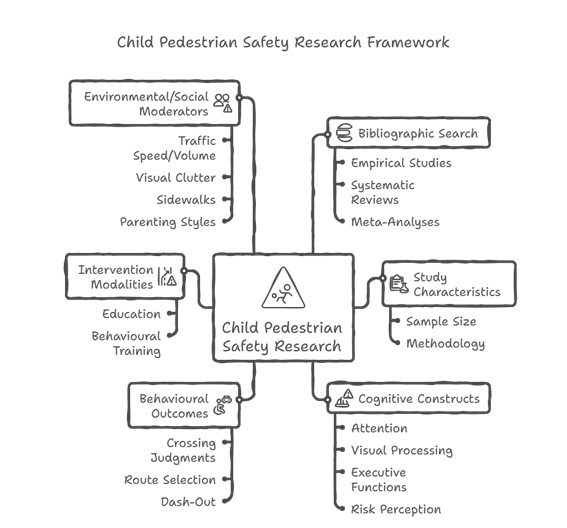
This paper summarizes evidence on road transport safety with a focus on children’s cognitive attitudes and pedestrian behaviour. It integrates findings on attention, visual processing, executive functions, risk perception, knowledge–behaviour transfer, and environmental complexity. Consistent evidence indicates that developmental limitations in attention and processing speed constrain safe crossing decisions in younger children. Knowledge-focused education alone does not reliably improve real-world behaviour, and behavioural training targeting procedural skills yields modest safety improvements. Built environment features – particularly traffic speed and volume, as well as visual clutter – systematically shape both perceived and objective safety outcomes. The paper concludes with implications for training, urban design, and family practices, and outlines directions for future research.
References
Amiour, Y., Waygood, E. O. D., van den Berg, P. E. W. (2022). Objective and perceived traffic safety for children: A systematic literature review of traffic and built environment characteristics related to safe travel. International Journal of Environmental Research and Public Health. 19(5), 2641. DOI: https://doi.org/10.3390/ijerph19052641
Barton, B. K., Ulrich, T., Lyday, B. (2012). The roles of gender, age and cognitive development in children’s pedestrian route selection. Child: Care, Health and Development, 38(2), 280–286. DOI: https://doi.org/10.1111/j.1365-2214.2010.01202.x
Cloutier, M.-S., Beaulieu, E., Fridman, L., Macpherson, A. K., Hagel, B. E., Howard, A. W., Churchill, T., Fuselli, P., Macarthur, C., Rothman, L. (2021). State-of-the-art review: Preventing child and youth pedestrian motor vehicle collisions: Critical issues and future directions. Injury Prevention, 27(1), 77–84. https://doi.org/10.1136/injuryprev-2020-043829
Oxley, J. A., Congiu, M., Whelan, M. I., D’Elia, A. D., Charlton, J. L. (2007). The impacts of functional performance, behaviour and traffic exposure on road-crossing judgements of young children. Annual Proceedings of the Association for the Advancement of Automotive Medicine. 51, 81–96. URL: https://pmc.ncbi.nlm.nih.gov/articles/PMC3217496/
Schwebel, D. C., Barton, B. K., Shen, J., Wells, H. L., Bogar, A. L., Heath, G., & McCullough, D. (2014). Systematic review and meta-analysis of behavioral interventions to improve child pedestrian safety. Journal of Pediatric Psychology. 39(8), 826–845. DOI: https://doi.org/10.1093/jpepsy/jsu024
Tabibi, Z., Pfeffer, K. (2003). Choosing a safe place to cross the road: The relationship between attention and identification of safe and dangerous road-crossing sites. Child: Care, Health and Development. 29(4), 237–244. DOI: https://doi.org/10.1046/j.1365-2214.2003.00336.x
Tapiro, H., Oron-Gilad, T., Parmet, Y. (2020). Pedestrian distraction: The effects of road environment complexity and age on pedestrian’s visual attention and crossing behavior. Journal of Safety Research. 72, 101–109. DOI: https://doi.org/10.1016/j.jsr.2019.12.003
Vijay, N. C., Rokade, S., Bivina, G. R. (2024). Towards safer streets: A review of child pedestrian behavior and safety worldwide. Transportation Research Part F: Traffic Psychology and Behaviour. 103, 638–660. DOI: https://doi.org/10.1016/j.trf.2024.05.005
Whitebread, D., Neilson, K. (2000). The contribution of visual search strategies to the development of pedestrian skills by 4–11 year-old children. British Journal of Educational Psychology. 70(4), 539–557. DOI: https://doi.org/10.1348/000709900158290
Zeedyk, M. S., Wallace, L., Carcary, B., Jones, K., & Larter, K. (2001). Children and road safety: Increasing knowledge does not improve behaviour. British Journal of Educational Psychology. 71(4), 573–594. DOI: https://doi.org/10.1348/000709901158686
Wazana, A., Krueger, P., Raina, P., Chambers, L. (1997). A review of risk factors for child pedestrian injuries: Are they modifiable? Injury Prevention. 3(4), 295–304. DOI: https://doi.org/10.1136/ip.3.4.295
WHO – World Health Organization (2021). Global Plan for the Decade of Action for Road Safety 2021–2030. Geneva: WHO. URL: https://www.who.int/publications/m/item/global-plan-for-the-decade-of-action-for-road-safety-2021-2030
WHO – World Health Organization (2023). Global status report on road safety 2023. Geneva: WHO. URL: https://digitallibrary.un.org/record/4030268?v=pdf&ln=hu