Development Tendencies in Air Traffic Management
Abstract
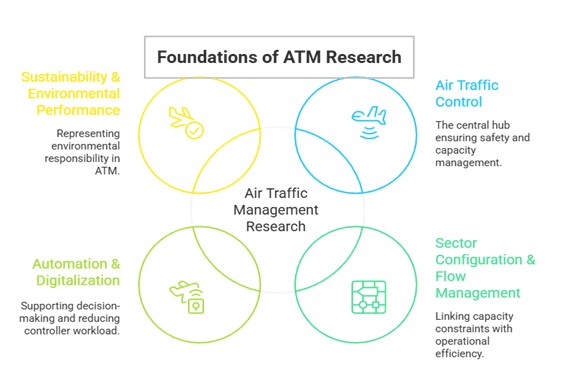
This paper investigates the evolution of research themes in Air Traffic Management (ATM) between 2014 and 2024 using keyword co-occurrence analysis. Five dominant clusters—safety and human factors, capacity and airspace efficiency, automation and digitalisation, trajectory-based operations, and sustainability—are identified and interpreted through a socio-technical lens. Beyond describing clusters, the study examines inter-cluster dynamics and situates findings within the policy frameworks of the ICAO Global Air Navigation Plan (GANP) and the European SESAR ATM Master Plan. The use of explicit criteria for keyword normalisation, clustering parameters, and validation metrics enhances methodological transparency. The paper proposes a targeted research agenda for underexplored areas, such as the practical integration of UAS and real-time machine learning in ATC operations. Finally, it outlines practical implications for regulators, ANSPs, technology developers, and training programs, and recommends methodological innovations.
References
Balta, E. (2024). The effects of increased mental workload of air traffic controllers on time perception in a secondary task. Acta Psychologica, Applied Ergonomics,115, 104162. https://doi.org/10.1016/j.apergo.2023.104162
Bowman, M. (2025). Team diversity in European air traffic management teams. Transportation Research Interdisciplinary Perspectives. Transportation Research Procedia, 88, 1-12. https://doi.org/10.1016/j.trpro.2025.05.001
Brangier, F. (1990). Communications with aircraft for civil air traffic control. IFAC Proceedings Volumes , 23(2), 1–7. https://doi.org/10.1016/S1474-6670(17)52642-7
Chen, D., Yin, J., Zhong, Y., & Tang, C. (2025). A two-layer air traffic dynamic network based en-route cascading dynamics modeling and multi-dimensional impact analysis. Reliability Engineering & System Safety, 264, 111350. https://doi.org/10.1016/J.RESS.2025.111350
Dhief, I., Wang, Z., Zhou, W., Alam, S., Stahnke, A., Losensky, L., Rabus, T., & Kaltenhäuser, S. (2025). A review of international best practices in integrating space operations with air traffic management: Guidance for future space launch operations. Acta Astronautica, 226, 728–759. https://doi.org/10.1016/j.actaastro.2024.10.010
Dmochowski, P. A. (2017). Air Traffic Smoothness as a Universal Measure for Air Traffic Quality Assessment. Procedia Engineering, 134, 237–244. https://doi.org/10.1016/j.proeng.2016.01.065
Dönmez, K., Çetek, C., & Kaya, O. (2022). Air traffic management in parallel-point merge systems under wind uncertainties. Journal of Air Transport Management, 104, 102268–102268. https://doi.org/10.1016/J.JAIRTRAMAN.2022.102268
Edwards, T., Homola, J., Mercer, J., & Claudatos, L. (2016). Multifactor interactions and the air traffic controller: The interaction of situation awareness and workload in association with automation. IFAC-PapersOnLine, 49, 597–602. https://doi.org/10.1016/J.IFACOL.2016.10.623
Edwards, T., Seely, R., Malakis, S., Evans, M., & Evans, A. (2023). An introduction to air traffic control and the application of human factors. In Human factors in aviation (3rd ed.). Elsevier. 449-475. https://doi.org/10.1016/B978-0-12-420139-2.00021-6
Esteve, P., & Zanin, M. (2025). Directs in European air traffic management: When and why are they actually granted? Journal of Air Transport Management, 125, 102766. https://doi.org/10.1016/j.jairtraman.2025.102766
Gu, H., & Wan, Y. (2020). Can entry of high-speed rail increase air traffic? Price competition, travel time difference and catchment expansion. Transport Policy, 97, 55–72. https://doi.org/10.1016/J.TRANPOL.2020.07.011
Guo, J., & Bard, J. F. (2024). Air traffic controller scheduling. Computers & Industrial Engineering, 191, 110123. https://doi.org/10.1016/j.cie.2024.110123
Hamdan, S. (2022). Air traffic flow management under emission policies: Analysing the impact of sustainable aviation fuel and different carbon prices. Transportation Research Part A: Policy and Practice. 166, 14-40, https://doi.org/10.1016/j.tra.2022.09.013
Hilton, S., Sabatini, R., Gardi, A., Ogawa, H., & Teofilatto, P. (2019). Space traffic management: towards safe and unsegregated space transport operations. Progress in Aerospace Sciences, 105, 98–125. https://doi.org/10.1016/j.paerosci.2018.10.006
Jakšić, Z., & Janić, M. (2020). Modeling resilience of air traffic control sectors. Journal of Air Transport Management, 89, 101891. https://doi.org/10.1016/j.jairtraman.2020.101891
Jasek, M. (1995). Enhanced visual displays for air traffic control collision prediction. IFAC Proceedings Volumes, 28(15), 553–558. https://doi.org/10.1016/S1474-6670(17)45290-6
Jimenez, M. A., Tello, F., & Mateos, A. (2020) A Variation of the ATC Work Shift Scheduling Problem to Deal with Incidents at Airport Control Centers. Mathematics, 8, 321. https://doi.org/10.3390/math8030321
Jou, R.-C., Kuo, C.-W., & Tang, M.-L. (2013). A study of job stress and turnover tendency among air traffic controllers: The mediating effects of job satisfaction. Transportation Research Part E: Logistics and Transportation Review, 57, 95–104. https://doi.org/10.1016/J.TRE.2013.01.009
Kistan, T., Gardi, A., Sabatini, R., Ramasamy, S., & Batuwangala, E. (2017). An evolutionary outlook of air traffic flow management techniques. Progress in Aerospace Sciences, 88, 15–42. https://doi.org/10.1016/j.paerosci.2016.10.001
Louie, R., Tai, T. S., & Liem, R. P. (2025). Flight trajectory grafting Leveraging historical trajectories for more efficient arrival air traffic management. Journal of Air Transport Research Society, 4, 100072. https://doi.org/10.1016/j.jatrs.2025.100072
Luu, V. T., Ho, T. V. H., & Pham, M. V. (2021). Development Of Air Traffic Control Simulator System Applied In Education And Training. Transportation Research Procedia, 56, 47–54. https://doi.org/10.1016/J.TRPRO.2021.09.006
Madhwal, Y. (2017). Planning in aircraft industry based on prediction of air traffic. Procedia Computer Science, 122, 1047–1054. https://doi.org/10.1016/j.procs.2017.11.472
Mangav, D., McDermott, O., & Trubetskaya, A. (2026). Implementing environmental efficiencies in aviation using lean six sigma in air traffic control. Research in Transportation Business & Management, 65, 101583. https://doi.org/10.1016/j.rtbm.2025.101583
Martin, A., Strzempkowski, B., Young, S., Fontecchio, A. K., Moore, L., Kaufmann, K., Willems, B., & Ruskin, K. J. (2020). Air traffic control (ATC) technical training collaboration for the advancement of global harmonization. Journal of Air Transport Management, 89, 101794–101794. https://doi.org/10.1016/J.JAIRTRAMAN.2020.101794
Mirchi, T., Vu, K. P., Miles, J., Sturre, L., Curtis, S., & Strybel, T. Z. (2015). Air Traffic Controller Trust in Automation in NextGen. Procedia Manufacturing, 3, 2482–2488. https://doi.org/10.1016/J.PROMFG.2015.07.509
Oehme, A. (2010). Distant air traffic control for regional airports. IFAC Proceedings Volumes, 43(13), 141–145. https://doi.org/10.3182/20100831-4-FR-2021.00026
Pacaux-Lemoine, M.-P., Debernard, S ,(2000). A common work space to support the air traffic control. Transportation Research Part F: Traffic Psychology and Behaviour, 33(12), 75–78. https://doi.org/10.1016/S1474-6670(17)37280-4
Pang, Y., Hu, J., Lieber, C. S., Cooke, N. J., & Liu, Y. (2023). Air traffic controller workload level prediction using conformalized dynamical graph learning Advanced Engineering Informatics, 57, 102113–102113. https://doi.org/10.1016/J.AEI.2023.102113
Pavlović, G., Jovanović, R., & Stanojević, M. (2023). Rostering of air traffic controllers – current practices in Europe, key performance trade-offs and future opportunities Journal of Air Transport Management, 113, 102472. https://doi.org/10.1016/j.jairtraman.2023.102472
Pavlović, G., Stanojević, M., & Jovanović, R. (2025). Cross-border capacity sharing in air traffic control: which area control centres in Europe are the best candidates? . Journal of Air Transport Management, 129, 102878. https://doi.org/10.1016/j.jairtraman.2025.102878
Philippe, C. (2025). Impact of ageing on air traffic controllers' sleep and fatigue: a field study. Transportation Research Precedia, 88, 323–330. https://doi.org/10.1016/j.trpro.2025.05.039
Pongsakornsathien, N., Safwat, N. E. D., Xie, Y., Gardi, A., & Sabatini, R. (2025).Advances in low-altitude airspace management for uncrewed aircraft and advanced air mobility. Progress in Aerospace Sciences, 154, 101085. https://doi.org/10.1016/j.paerosci.2025.101085
Reva, O. M., & Borsuk, S. P. (2015). Air Traffic Control Students Tendencies of Desirability Levels during Flight Norms Violations. Procedia Manufacturing, 3, 3049–3053. https://doi.org/10.1016/J.PROMFG.2015.07.850
Reynolds, T. G. (2014). Air traffic management performance assessment using flight inefficiency metrics. Transport Policy, 34, 63–74. https://doi.org/10.1016/J.TRANPOL.2014.02.019
Rezo, Z., Steiner, S., Mihetec, T., & Čokorilo, O. (2023). Strategic planning and development of Air Traffic Management system in Europe: A capacity-based review, Transportation Research Procedia, 69, 5–12. https://doi.org/10.1016/j.trpro.2023.02.138
Rosenow, J., & Fricke, H. (2019). Impact of multi-criteria optimized trajectories on European airline efficiency, safety and airspace demand. Journal of Air Transport Management, 78, 133–143. https://doi.org/10.1016/j.jairtraman.2019.01.001
Ruskin, A. C., Moore, L., Kaufmann, K., Willems, B., & Ruskin, K. J. (2024). Creation of a novel microburst alarm for Air Traffic Control using a signal design framework. Transportation Research Interdisciplinary Perspectives, 27, 101239–101239. https://doi.org/10.1016/J.TRIP.2024.101239
Salmon, C., Jacquemin, B., Vienneau, D., de Hoogh, K., & colleagues. (2025). Traffic-related air pollution and childhood acute leukemia in France: GEOCAP nationwide case-control study. Environmental Research, 288, 123303. https://doi.org/10.1016/j.envres.2025.123303
Shamsiev, Z. Z. (2022). Organizational factors affecting the effectiveness of the educational process of training air traffic controllers. Heliyon, 8, e11801. https://doi.org/10.1016/j.heliyon.2022.e11801
Sheeja Rani, S., Aburukba, R. (2025). Extreme gradient boosting approach for air traffic data analysis in pandemic conditions. Franklin Open, 13, 100384. https://doi.org/10.1016/j.fraope.2025.100384
Skorupski, J. (2017). About the need of a new look at safety as a goal and constraint in air traffic management. Procedia Engineering , 187, 117–123. https://doi.org/10.1016/j.proeng.2017.04.357
Socha, V. (2020). Workload assessment of air traffic controllers. Transportation Research Procedia, 51, 243–251. https://doi.org/10.1016/j.trpro.2020.11.027
Standfuss, T. (2024). Efficiency assessment in European air traffic management:A fundamental analysis of data, models, and methods. Journal of Air Transport Management, 115, 102523. https://doi.org/10.1016/j.jairtraman.2023.102523
Stamenić, A., Čokorilo, O., Vujačić, J. P., & Radojković, N. (2025). Civil aviation security and the economy. Transportation Research Procedia, 83, 585–592. https://doi.org/10.1016/j.trpro.2025.03.029
Suárez, M. Z. (2024). Understanding the research on air traffic controller workload and its implications for safety: A science mapping-based analysis. Safety Science, 176, 106545. https://doi.org/10.1016/j.ssci.2024.106545
Tafur, C. L., Camero, R. G., Rodríguez, D. A., & Rincón, J. C. D. (2024). Applications of artificial intelligence in air operations: A systematic review. Results in Engineering, 25, 103742. https://doi.org/10.1016/j.rineng.2024.103742
Torres, S. (2012). Swarm theory applied to air traffic flow management. Procedia Computer Science, 12, 463–470. https://doi.org/10.1016/j.procs.2012.09.105
Vrancken, P., Cabon, P., Frantz, B. (2025). Assessing Fatigue Risk and Mitigation Strategies for Air Traffic Controllers in European Air Traffic Service Providers. Transportation Research Procedia, 88, 315–322. https://doi.org/10.1016/j.trpro.2025.05.038
Weigang, L. (2021). Air Traffic Flow and Capacity. International Encyclopedia of Transportation,, 380–389. https://doi.org/10.1016/B978-0-08-102671-7.10350-1
Zombré, P., Guitart, A., Delahaye, D., Olanrewaju, O. A., & Krykhtin, V. (2025). Flight centric complexity and allocation of flights to controllers. Journal of Air Transport Management, 131, 102906. https://doi.org/10.1016/j.jairtraman.2025.102906