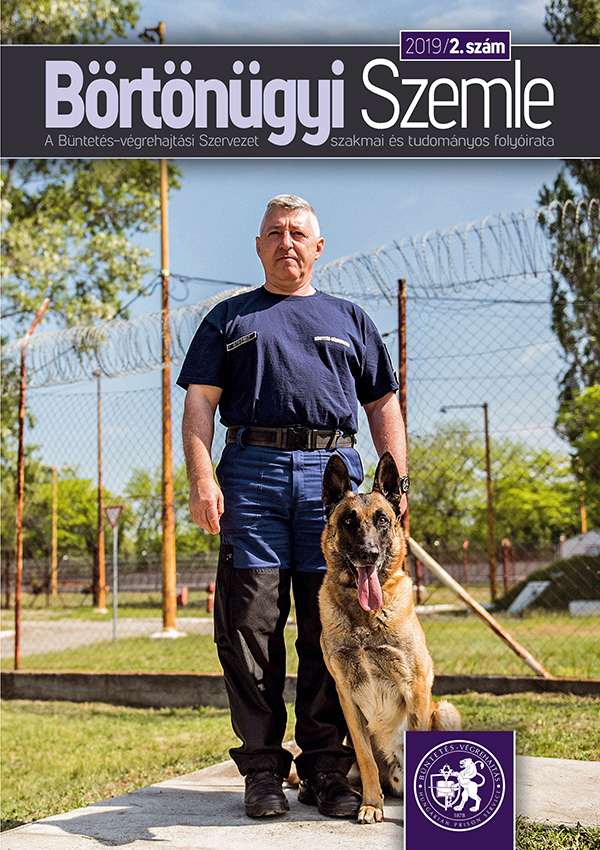
Reintegration activities of the Hungarian Prison Service – the best practices of the Szeged Strict and Medium Regime Prison
Abstract
In the course of the reintegration of prisoners, the Szeged Strict and Medium Regime Prison draws on the experience gained during the past of the institute, and therefore supports the prisoners who are willing to volunteer during the time of their punishment and cooperate voluntarily in achieving the goals of reintegration. In addition to classical reintegration activities - primary school education, specialized training, employment, therapeutic employment - the Szeged Strict and Medium Regime Prison has a centuries-old tradition of participating in cultural and leisure programs. In the practice of the Prison, we implement the reintegration programs of the Hungarian Prison Service, taking into account the expected individual activity of the prisoners, enforcing the imposed judgment and at the same time excluding the disadvantage hindering factors as far as possible and mediating the socially accepted positive values. Amongst the Hungarian prisons the Szeged Prison was the first to introduce college and university education for the long-termed convicts, and introduced several reintegration programs that had an incentive to develop a long-term treatment concept for sentenced prisoners.
References
Albert Fruzsina (szerk.): Életkeretek a börtönön innen és túl. Szubjektív reszocializációs esélyek. Szociológiai Tanulmányok 2015/2.
Albert Fruzsina – Bíró Emese: A sikeres reintegráció. Albert Fruzsina (szerk.): Életkeretek a börtönön innen és túl. Szubjektív reszocializációs esélyek. Szociológiai Tanulmányok 2015/2.
An Environmental Approach to Positive Emotion: Flowers. Evolutionary Psychology (2005)
Antalóczy Péter (2014): A vallás szerepe a fogvatartottak reszocializációjában. Börtönügyi Szemle 2014/4.
Balázs Péter (2017): Reintegrációs tevékenység, oktatás, felzárkóztatás, börtönszínház. Börtönügyi Szemle 2017/1.
Bíró Emese (2015): A fogvatartottak családi kapcsolatainak szerepe a bűnelkövetésben, a börtönélményben és a reintegrációban. Albert Fruzsina (szerk.): Életkeretek a börtönön innen és túl. Szubjektív reszocializációs esélyek. Szociológiai Tanulmányok 2015/2.
Bolgár Judit (2018): A reintegráció fogalmi megközelítése a deviancia jelentéstartalmán keresztül. Börtönügyi Szemle 2018/1.
Csukai Magdolna (2014): A börtönoktatás mint a reszocializáció eszköze. Börtönügyi Szemle 2014/4.
Fűzi Beatrix: Neveléstan. Online: https://www.tankonyvtar.hu/hu/tartalom/tamop412b2/2013-0002_nevelestan/tananyag/JEGYZET-19-3.3._A_csaladi_es_iskolai_nev.html (Letöltve: 2019. 04. 9.)
Juhász Zsuzsanna (2016a): Művészei programok és művészetterápia börtönkörnyezetben. Börtönügyi Szemle 2016/4.
Juhász Zsuzsanna (2016b): Börtön és sport. Börtönügyi Szemle 2016/3.
Kassai Attila (2008): A szakképzés speciális pedagógiai kérdései börtönkörülmények között. Egy kérdő-íves felmérés tapasztalatai. Börtönügyi Szemle 2008/3.
Miklósi Márta (2016): A büntetés-végrehajtási szervezet reintegrációs tevékenységeinek új rendszere. 2016/5.
Vári Krisztina Ágnes (2018): Az intézeti vallásgyakorlás szerepe a reintegrációs folyamatokban. Börtönügyi Szemle 2018/3.